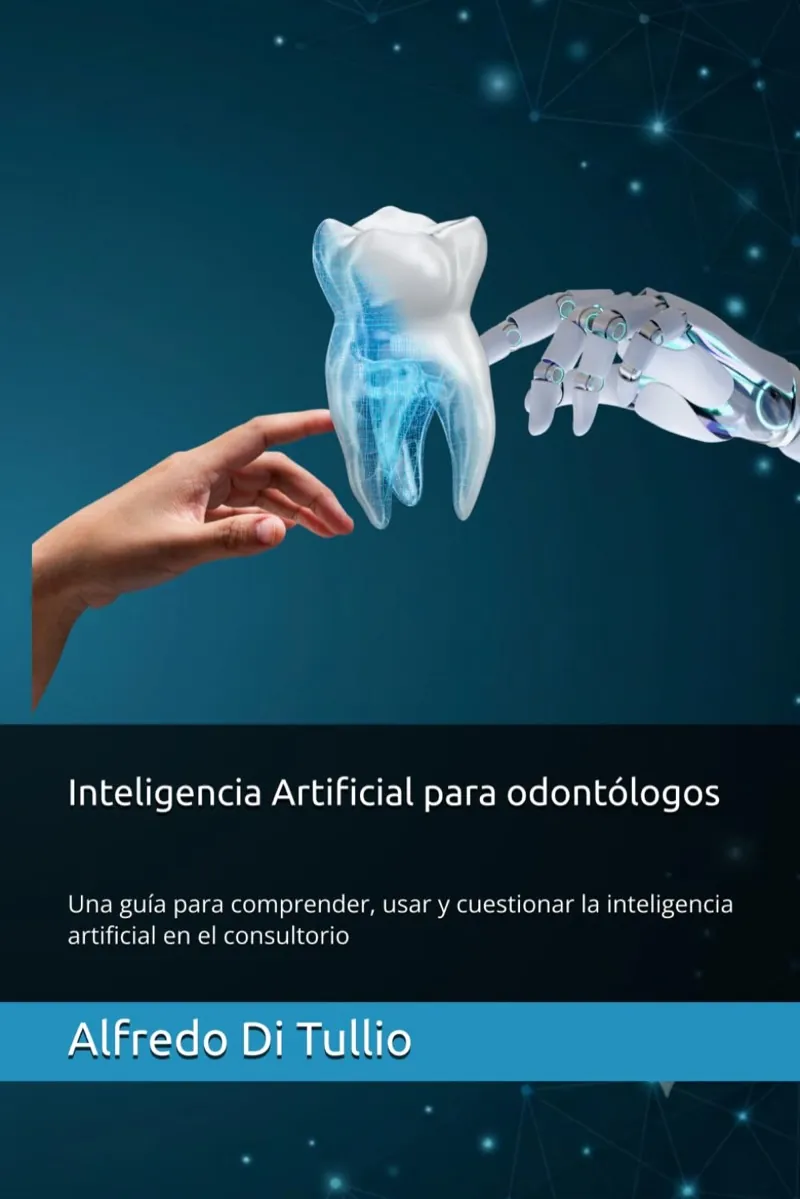
A colleague recently asked me, over coffee in Melbourne, whether artificial intelligence was going to replace the dentist. I said no. Then I said yes. Then I stayed quiet for a long while and told him the truth — the most uncomfortable answer: it depends on what we mean by dentist, by replace, and by artificial intelligence. This book is an attempt to give our profession the words to have that conversation seriously.
Why I wrote it
We're debating the future of dentistry without the words to name what's happening. We argue about whether AI will replace us before we've defined what an AI is; whether it will fail before understanding why it fails; whether it's useful before knowing what kind of "useful" we should even expect. That confusion is the real problem — and it's the gap this book was written to close.
It isn't a book to turn you into an engineer, and it isn't a book to sell you software. It's a book written by a dentist for other dentists, in the language spoken in clinics — not the one spoken at tech conferences. Written, too, by someone who went and built dental software from the inside, and can therefore tell you, with names and specifics, what these tools can and cannot do today. And why the right answer is often not the one you'll like most.
The problem it solves
When I started looking for references, I found something that surprised me: in Spanish, on AI applied to dentistry, written for dentists by someone who is also a dentist, there is almost nothing. There are scattered journal articles, blog posts from software vendors, a few titles translated from English that assume technical familiarity no Latin American dentist is obliged to have, and an ocean of social-media posts swinging between hype and apocalypse — many written by people who are neither dentists nor know how a language model actually works.
That's the landscape: a lot of noise and very few conceptual tools to think seriously about what's coming. This book gives you the vocabulary — machine learning, LLM, RAG, hallucination, clinical decision support, algorithmic bias — each explained with a dental example, so that when a term shows up you're not buying smoke. The right words are what protect you from a bad purchase, a legal exposure, or a promise that was never going to hold.
Who it's for
You don't need to know how to program, or any maths, or to have ever read a line about AI. You just need curiosity and the desire to understand what's about to change in the profession you chose. My ideal reader is a dentist who works — who sees patients, wrestles with records, argues with the insurer, and ends the day thinking about the admin still left to do. Students will find the vocabulary the faculty won't give them; engineers and software people are welcome too, though they'll find deliberate simplifications, because I'm not writing for them.
What's inside
Sixteen chapters plus an epilogue, built as a single conversation — from how these tools work to the ethics of letting a machine near a clinical decision:
- Dentistry at a turning point
- A map of AI for dentists
- Detection, diagnosis and decision
- Trust and hallucinations
- Clinical documentation and patient communication
- Privacy and patient data
- Image-assisted diagnosis: the state of the art
- Clinical decision support systems
- How to evaluate an AI tool
- The dentist's new role
- Ethics of AI in healthcare: a framework
- Accountability, bias and consent
- Can a machine make a clinical decision?
- The clinic of 2035, and what to do today
From theory to the operatory: DentalCore
I'll say something uncomfortable up front, the same way I do in the book: I build dental software. It's called DentalCore, and I'm its founder. It appears several times in these pages — especially where I talk about systems that help the dentist decide — not to sell it to you, but because it would be dishonest to pretend it doesn't exist when it's the reason I learned, up close, many of the things I'm telling you. I use it as one example among many when it fits, and as a counter-example when that fits too.
Building it is what let me write this book: on one side of the table, a dentist who sees patients; on the other, a developer who writes the code dentists end up using; and in the middle, someone with a philosophy background who insists on asking why before how. That crossing is the whole point — and it's why the book keeps its distance from both the hype and the panic. dentalcore.app.
A pact
Writing about AI in 2026 is a trap: the temptation to sound visionary and sell predictions I can't back up is enormous. I'd rather do something else — tell you what I know, what I don't, and what nobody knows yet, and be explicit about which of the three I'm saying at each moment. I'd rather you leave with better questions than you arrived with, so that the next time someone tries to sell you the next miracle, you have the tools to ask the right thing before signing anything.